However, for some time, the arts and social sciences have been a political monoculture. LIWC is used in research to analyze the ways people use words when communicating, which can provide rich information about their beliefs, fears, thinking patterns, social relationships, and personalities. All of this seems to me to be kept in the dark—crucial, basic definitions deliberately omitted, which is not just anti-philosophical but anti-intellectual. My wish list is too long, but I also wish he had interlocutors from political theory as well, as one wonders how he would reckon with historical work on the rise of liberalism, which emphasizes the historical role "identify politics" has helpfully played in our current system of rights.
The Science Of Revenge: Why Getting Even Feels So Good

Yet no matter how wrong, shameless, or moronic the unintellectual dark web becomes, it continues to gain steam. Its members make up the unintellectual dark web, where “unintellectual” doesn’t necessarily describe its members — well, not all of them — but it certainly describes its members’ output. The “intellectual dark web” first came about as a joke told by investor Eric Weinstein. Much of this audience is composed of young men for whom these entertaining take-downs of political correctness is their first exposure to “intellectual” discussions of politics and culture. Today, magazines like Current Affairs dedicate much of their content to debunking the claims of dark web figures while also addressing the limited effectiveness of “social justice warrior” politics.
The Intellectual Dark Web: A History (and Possible Future) Paperback – March 17, 2025
The rise of podcasting coincided with campus politics spilling over into the wider world. The party of JFK, of Dr Martin Luther King … The big tent party that welcomed and encouraged this marketplace of ideas.” “The people in charge of the Democratic party… have created this cult-like atmosphere,” she said. Many of these figures, the Times noted, were building their own media channels.
On YouTube
Well, because of Duverger’s Law, because of the historical reality of the last 250 years of the United States, it looks like choosing one of two political parties as your vehicle for political change and as a necessary operator in your theory of social, intellectual, cultural, and political change. You have a splintering, you have a decomposition, you have really, honestly, a collapse of this movement as a coherent ideological force, intellectual force, and certainly political force. Although the movement deserves credit for pointing out the problem of left-wing overreach in America’s institutions, this critique is now part of conventional wisdom and is no longer sufficient. These new figures were also using new media, especially podcast platforms, to reach younger audiences and generate buzz for their intellectual movement. Weinstein and Heying recently sat down with Kmele Foster and I for a wide-ranging Fifth Column conversation about the IDW, campus free speech, identity politics, the race/IQ minefield, and Weinstein's (questionable!) ideas about regulation in academia and media. Whatever the adjectives, it's a group of people, many of them familiar to Reason readers, who are interested in free speech and free thought, sensitive to intellectual conformity, and adept at using new media to route around hostile gatekeepers.
The 100 Best Comedy Movies Of All Time
In the spirit of the IDW, I wanted the book to be accessible to a wide audience. When I first decided to write a book about the IDW, I knew I didn’t want to write a “scholarly” work. The issue, it turns out, was not the content itself—what the complaint was about—but that the book was not sufficiently scholarly; amongst other things, it needed to engage more with “theory.” The publisher investigated the book and determined that the book could not return to sales in its current form. Two weeks after being released, however, it was suspended from sales following a complaint (or complaints). I wrote a book about the Intellectual Dark Web (IDW) that was originally published in early 2024 by an academic publisher.
What Is The Intellectual Dark Web?
If those kids who actually haven't spent much time racing down hills on bikes or climbing trees and falling and experiencing gravity in real time, are told, "Actually, objective reality is a sign of the patriarchy and it's about power and it's not actually about reality," that feels really confirming to certain people. And it's in part—these issues have been discussed widely—but it's about the rise of iPhones and tech and the decrease in children spending time outside and getting physical experience with their world, and becoming more social creatures. This is all terrible metaphors here, I recognize, but the way that you posited this is maybe it's just a society-wide thing and the campus is a place where obviously people are ready to go and kind of clash and do battle, as it always is.
Weiss subsequently set up a Substack newsletter that became a multi-contributor magazine, the Free Press, and a podcast—thus migrating into the independent media-land of the IDW. THESE ISSUES ALSO HAVE SOME relevance to Bari Weiss’s own career six years after she first introduced the IDW to the wider public. Why some people are less susceptible to this mentality than others is a question that undoubtedly has multiple answers. The very framing, she wrote, implied that the featured “heretics” were huddling in dark corners or catacombs to exchange forbidden opinions; in Dreger’s view, it also valorized opinions over facts and easily lent itself to prioritizing “clicks, skirmishes, and dramatic photos at sunset”—a dig at the cringey pictures illustrating the article, which showed its protagonists in eerily dark forest settings, clearly meant to convey that there was something shadowy and forbidden about their activity. Bioethicist Alice Dreger, who left Northwestern University in 2015 with complaints about administrative censorship and has been targeted for campus protests over accusations of “transphobia,” refused Weiss’s invitation to be included in the IDW article for several reasons. Several people who got pulled into our orbit were bad actors from the beginning—Trumpist grifters and conspiracists—and a few of the original members got corrupted or revealed their truer, baser selves.
Bessent Says Mamdani Is ‘clearly’ A Leader In Democratic Party After ‘great Campaign’
The next time we find ourselves either in the audience or on stage in a dark conversation, let’s start with humility and an honest investigation of ourselves. Given how influential this group is becoming, I can’t be alone in hoping the I.D.W. finds a way to eschew the cranks, grifters and bigots and sticks to the truth-seeking. Insisting that you “actually” believe the thing which just so happens to be what your audience with fistfuls of dollar bills wants to hear is much easier, and it allows you to retain some internal dialogue as an objective authentic crusader of truth. Something like facing the truth that you are the kind of person who can be easily manipulated and swayed by the trappings of money, sex, or status is a kind of ugly truth.
- Weinstein coined the term "intellectual dark web", later popularized by Bari Weiss, an opinion editor for The New York Times.
- It is a place where ideas are freely exchanged as they ought to be.
- With neoliberalism finally being challenged within the Democratic party beginning with the rise of Sen. Bernie Sanders, many libertarians began imagining that the party had somehow betrayed its beliefs, instead of realizing the truth that Democrats gone astray under Clinton.
- If the dark web arouses the anger of certain commentators in the media or the academy, it is for the same reasons that new technologies in the internet age are “disruptive.”
Dave Rubin: Why The ‘Intellectual Dark Web’ Split Up
Still, she is obviously troubled by the new movement’s tendency to embrace right-wing conspiracists such as Pizzagate rumormonger Mike Cernovich, lite-alt-righter Milo Yiannopoulos, and the frothing conspiracy theorist Alex Jones. Today, contrarianism on race and gender is liable to get fierce pushback in the publications of mainstream liberalism. The New Republic — which Ta-Nehisi Coates has asserted had perhaps two black staff writers or editors in its heyday and was certainly overwhelmingly white — is now being edited by the leftist multicultural barbarians. What they all share is not a general commitment to intellectual free exchange but a specific political hostility to “multiculturalism” and all that it entails. Not only was it considered acceptable for pundits to speculate about the limitations of other races or women, or to engage with the nastier corners of the intellectual right, but it was often seen as a good thing — a sign that one was tough-minded and decidedly not beholden to 1960s-era leftism. Leon Wieseltier, who ran the New Republic’s book section as an independent barony, sought to exercise a droit du seigneur over female employees, as we learned last year.
A few years later, he returned to the United States, which he began treating as a satanic force following the Supreme Court’s Roe vs. Wade decision which established a national right to abortion. But Bozell’s convention speech line that “extremism in the defense of liberty is no vice” set off alarm bells among the general public, and Goldwater went down in flames. A bombastic convert to Roman Catholic fundamentalism, Buckley’s brother-in-law was insistent that everyone be made to live according to his newfound beliefs, and he shoved them into the public eye at every opportunity, most prominently as the ghostwriter for Arizona Sen. Barry Goldwater, the Republican Party’s 1964 presidential nominee. Welch went even further, writing a book advancing the obnoxiously stupid notion that Eisenhower was an agent of the Soviet Union. Incensed at Eisenhower and the conservatives, the self-described “individualists” worked tirelessly to impose their ideology on the Republican Party and the nation as a whole. The necessity of rebranding the right began during Franklin Roosevelt’s administration when his opponents utterly destroyed their credibility with the public by urging the federal government to do nothing to stop the Great Depression and then later by singing the praises of Adolph Hitler while trying to stop the U.S. from entering World War II.
The political Left for the foreseeable future is captured by its vanguardist faction. How can we have public policy that doesn’t adopt these as the new governing principles of our country? It is a kind of cancer to intellectual rigor, to progress, to good governance.

In short, Rubin’s origin story as a “public intellectual” is inextricably linked to Harris. Rubin has frequently said that his political “awakening” (or why he “left the left”) was inspired by watching Harris and Ben Affleck argue about Islam on an episode of Real Time with Bill Maher. In particular, Szeps expressed frustration with what he describes as the groupthink among mainstream outlets on certain topics of which reasonable disagreement should be able to take place—such as allowing psychiatrists some latitude on how to treat children with gender dysphoria without labeling them transphobic, or whether certain vaccines make sense for every person.
If you asked any number of the people who you may be thinking of while reading this essay if they really believed the things they were saying or doing, I have no doubt they would plainly say they do. This phrase is bandied about as a simple explanation for trajectories of certain personalities who seemed to have done a rapid philosophical and political 180. It is sometimes the best explanation and most compassionate stance we can take.
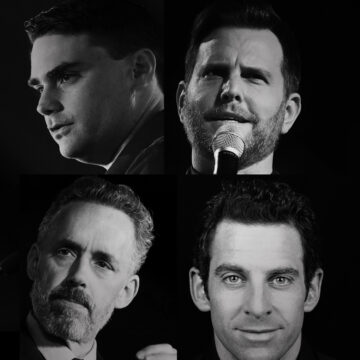
Campus leftists and their allies in the media are often no more open to alternative perspectives than the New Republic white male elite of two decades ago; they can behave badly too. Structural arguments about the oppression of black people and women didn’t often make it into mainstream publications. Hence, intellectual centrists prided themselves on their political independence from both sides of the political spectrum but were often more at pains to distinguish themselves from the left than from the right. The truth is rather that dark web intellectuals, like Donald Trump supporters and the online alt-right, have experienced a sharp decline in their relative status over time. "At the deepest level, I struggle to understand why so many people put social games ahead of truth," concluded Roberts. The premise of the book is that left-wing racialist ideology is a threat to the country—it’s a threat to not only the country as a whole, but a threat to all of the individual racial and ethnic groups in the country.
Next Reads
Weinstein says our institutions need people who can stand up to the pressures of conformity and authority. But in fact, if they don’t make use of the tiny number of people functioning as individuals or in small organizations, all of this is going to collapse because it cannot continue along its current exponential path. Well, very quickly that ability to grow runs out, and then people want to know, “Why am I stuck in a position going nowhere? “That means that you’re set up, potentially for war, for civil unrest, for communism if people try to grab what their neighbor has, or fascism if people try to maintain order at all costs.” So, what happens when you deny people the ability to continue on the path to which they’re so addicted?
Political scientist Daniel W. Drezner argues that the IDW contributes to polarization because of its need to appeal to a primarily right-wing audience, despite the political leanings of individual members. IDW commentators tend to dismiss issues of transgender rights and racial and gender inequality as the concerns of leftist "social justice warriors" while welcoming some gay men, such as Murray and Rubin, into their ranks. They often claim to have been unfairly treated by mainstream media and higher education institutions, which they say have been pressured into avoiding controversial topics. The first recorded usage of the term was on a 2017 episode of Sam Harris's podcast, when Weinstein used it to refer to a group of thinkers, including Weinstein and Harris, who used digital media to offer alternatives to mainstream media narratives. Media studies scholar John Postill argues that Weiss's essay, titled "Meet the Renegades", was a "defining media event" that offered an identity and cast of characters for the "anti-woke" movement to follow.